
Homelabber's $3,500 build straps four 32GB Nvidia V100s to a Lenovo mini PC for 128GB of VRAM
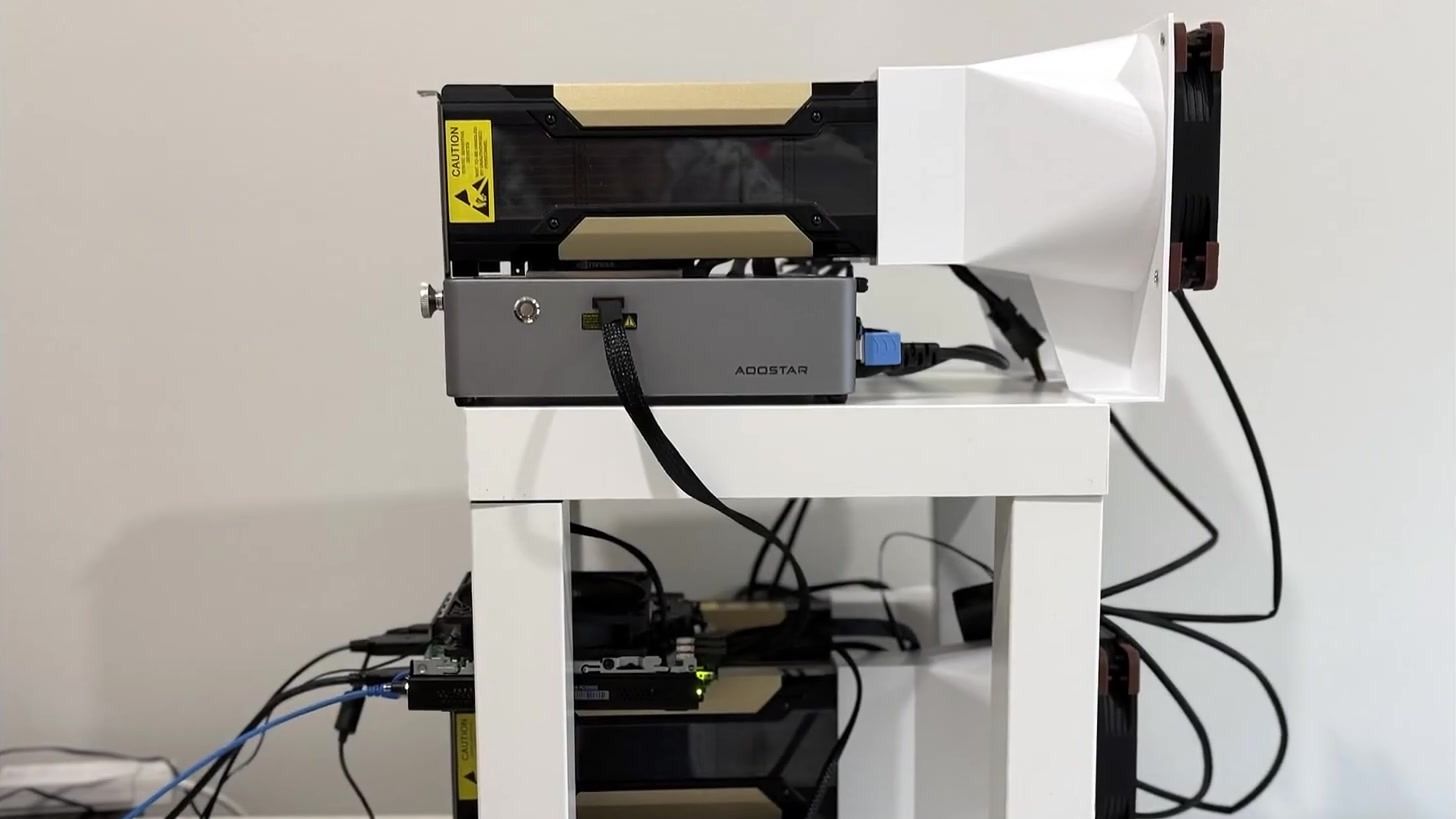
A homelab builder runs four used Nvidia Tesla V100 32GB GPUs off a Lenovo ThinkCentre M720q Tiny over OCuLink for 128GB of VRAM.
A homelabber has built a local AI system out of four used 32GB Nvidia V100s and a refurbished Lenovo M720q Tiny mini PC. Ok_Kaleidoscope9103’s construction, detailed on Reddit , relies on the GPUs going over four OCuLink cables from a PCIe switch card, with a solder bridge on the riser and coreboot getting past a BIOS that only booted two cards. The quiet-running build has the full 128GB of VRAM and can hit about 285 tokens per second in total running Qwen3.8-27B across its four cards. 4x Tesla V100 32 GB (128 GB VRAM) hanging off a Lenovo M720q Tiny over OCuLink - ~62 dB, ~A$6.5k all-in from r/homelab The user, who gives his name as Michael, details his “home AI box” in a YouTube video billed as a “full build guide.” The Australian builder describes the setup as “four docks, four datacentre cards, one little PC” in a “noise optimised build.” (Image credit: Michael L/YouTube ) The hardware for this particular build is based on a Lenovo M720q Tiny desktop, which has an i5-9400T CPU with 64GB of DDR4. With a matching Lenovo 01AJ940 riser and a CEACENT CNOL4PE08 PCIe switch card — this has a 24-lane PEX8724 switch on board for an x8 link in and four x4 OCuLink ports out — each GPU card can run at PCIe Gen3 x4. OCuLink is an external PCIe cable connector often used with external GPUs (eGPU). On the software and firmware end, the Tiny had some roadblocks that had to be overcome. It “only powers its riser slot when the card pulls the presence pin,” which the switch card doesn’t, so a solder bridge was needed on the back of the riser. Then, “Lenovo’s BIOS only leaves a 128 GB window for 64-bit devices,” and each 32GB V100 needs 64GB, which limits the stock firmware to just two cards; a third “hangs at POST.” His workaround used coreboot 26.09 built for the board with an EDK2 payload and a config setting that allows above-4G allocation. This expands the window to about 486GB and, with three patches, more features were enabled: the riser slot is always on, there is a Wake-on
Verified Source Intelligence
Tom's Hardware
Homelabber's $3,500 build straps four 32GB Nvidia V100s to a Lenovo mini PC for 128GB of VRAM
Read on Tom's Hardware