
Penguin shows off photonic memory box at SC26 that can expand AI accelerator capacity over optical links
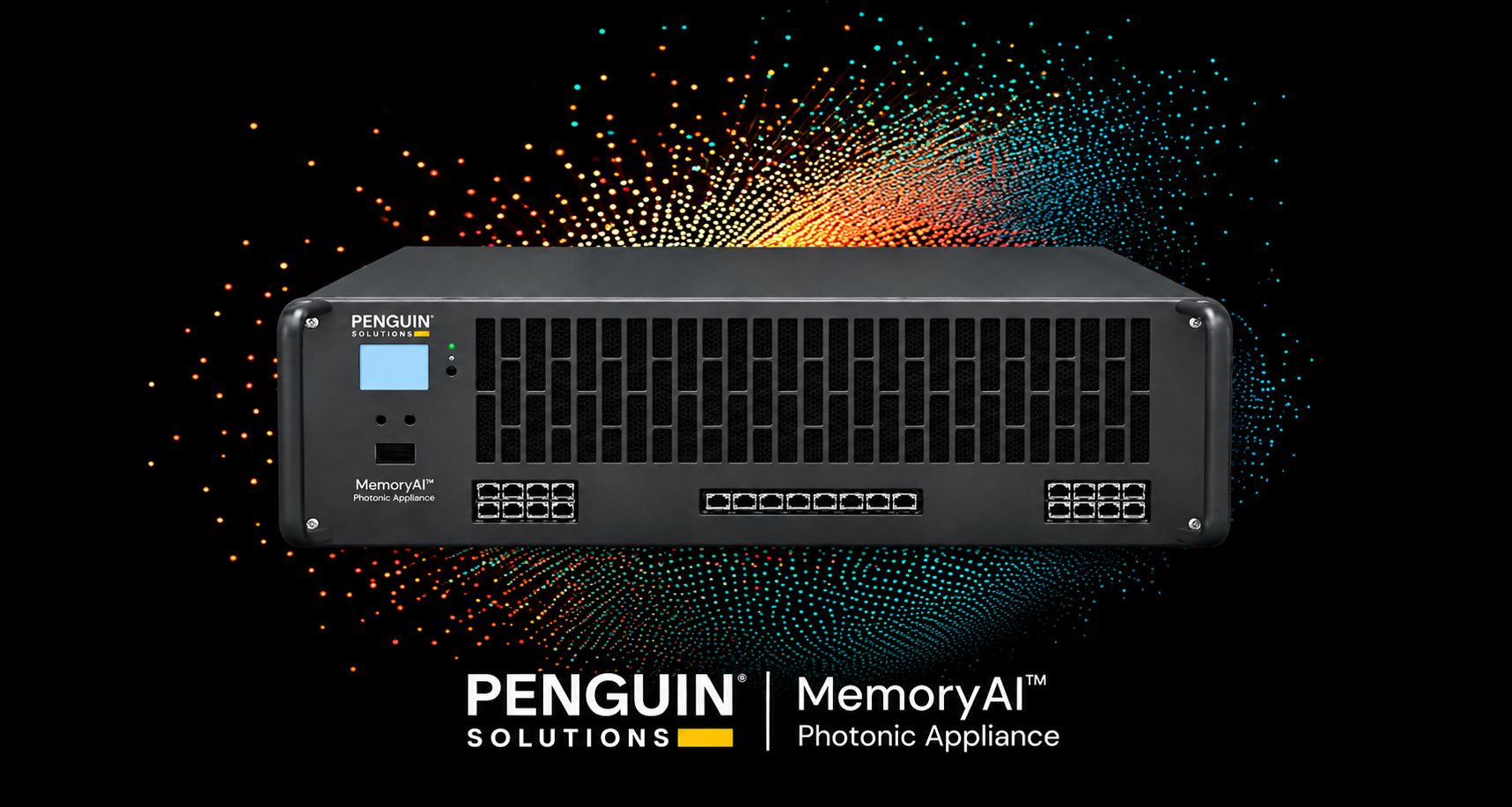
Penguin Solutions demonstrates external memory box with up to 576 GB of HBM3E and 16 TB of DDR5 inside that connects to hosts using optical links. There is a major caveat with this one as it does not seem to support existing servers and accelerators.
Penguin Solutions showed off its MemoryAI Photonic Appliance remote memory system at Supercomputer 2026 ( SC26 ), with customer samples scheduled for the second half of 2027. The device supports up to 576 GB of HBM3E with an aggregate bandwidth of up to 7.2 TB/s, and connects to systems using optical interconnects via the CXL.mem 3.1 protocol. HBM memory capacity is usually one of the major bottlenecks of contemporary AI accelerators, which is why, when developers face it, they tend to add or upgrade their accelerators. Penguin Solutions' new device aims to solve that, but there are drawbacks. The MemoryAI Photonic Appliance is designed to accommodate up to 576 GB of HBM3E and 16 TB of DDR5 memory, with overall bandwidth targeting 7.2 TB/s. The external memory box supports three memory access configurations: HBM Direct Mode, HBM-DDR5 Cached Mode, and DDR5 Direct Mode. The first provides access to external HBM3E, the second combines HBM3E and DDR5 in a tiered memory sub-system with HBM3E acting like a write-through cache for DDR5, while the third provides access to DDR5 without an intermediate HBM cache. Meanwhile, hardware semaphores (HSEMs) enable software-managed memory consistency across multiple host processors (i.e., if more than one host processor accesses the same memory location, software can use semaphores to ensure that only one host processor can modify data). (Image credit: Marvell) The Penguin appliance relies on Marvell's architecture that consists of Photonic Fabric Memory Modules (PFMMs) and Photonic Fabric network interface cards (PF-NICs). The device uses eight PFMM modules; each integrates a memory controller, eight DDR5 DIMM interfaces, 72 GB of HBM3E cache, and a photonic interposer with 16 transmit and 16 receive channels operating at 224 Gbps. This provides approximately 7.2 Tbps of aggregate bidirectional optical bandwidth per module, or 57.6 Tbps (7.2 TB/s) for the entire appliance, equivalent to approximately 3.6 TB/s in each direction. (Im
Verified Source Intelligence
Tom's Hardware
Penguin shows off photonic memory box at SC26 that can expand AI accelerator capacity over optical links
Read on Tom's Hardware